

Picking your SEO tool feels a bit like choosing a trusty kitchen knife. Get the right one, and every task feels smooth. Get the wrong one, and you fight your tools all day long! Two names dominate the conversation whenever marketers talk shop: Ahrefs and Semrush. Both are powerful. Both are popular. And both can seriously level up your search rankings.
So the big question remains: which is better, Ahrefs or Semrush?
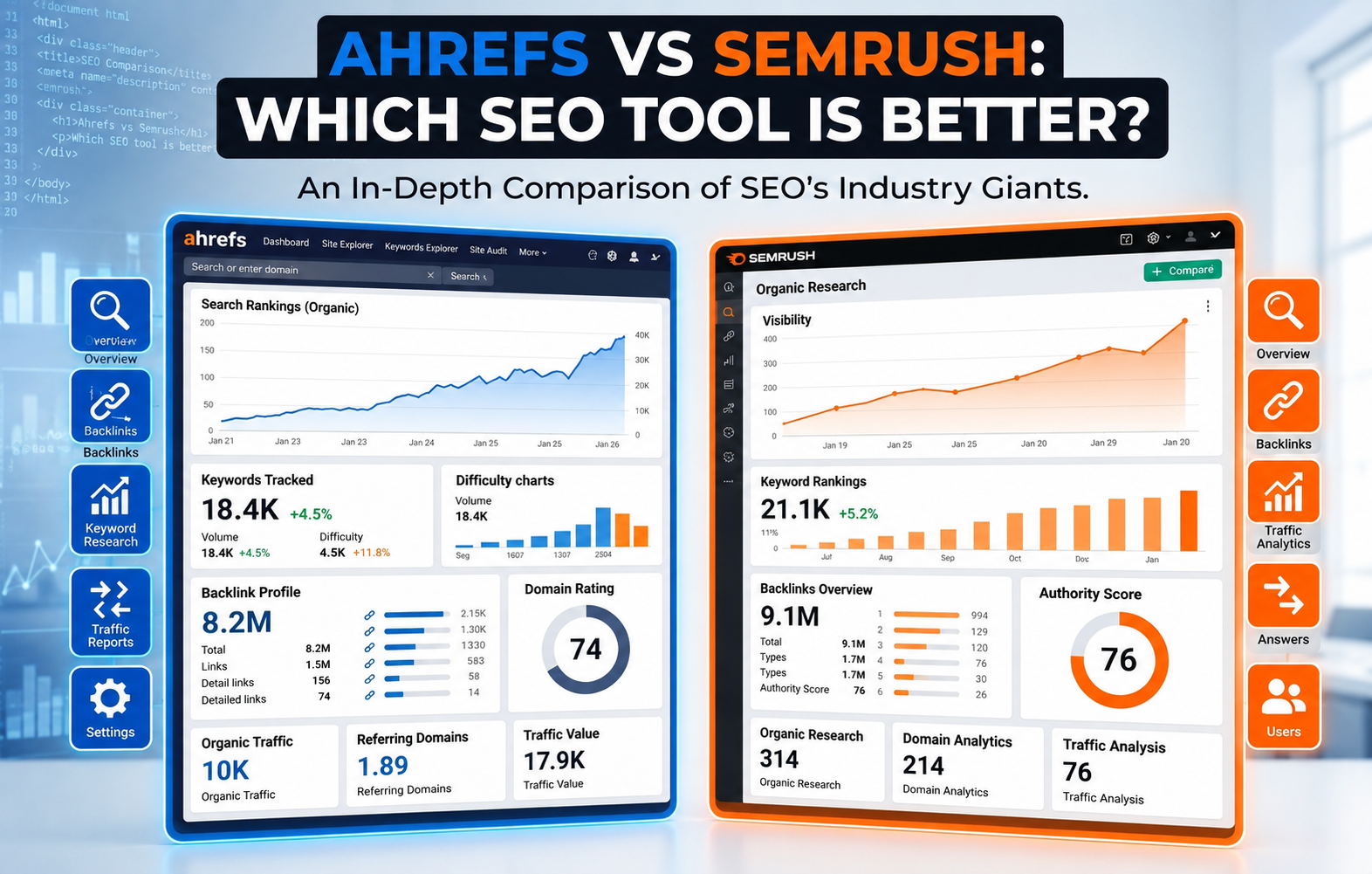
In this Ahrefs vs Semrush comparison, we will walk through everything you need to know. We will cover keyword research, backlinks, competitor analysis, site audits, rank tracking, content marketing, ease of use, and pricing. By the end, you will know exactly which platform fits your goals, your budget, and your workflow.
Quick Verdict
Short on time? Here is the fast answer.
Ahrefs is particularly strong for backlinks, content research, and SEO focused workflows. Semrush offers a broader digital marketing toolkit that stretches well beyond SEO into PPC, social, and more. The better choice depends on your SEO goals, your budget, and the features you need most.
If backlinks and pure SEO are your world, lean toward Ahrefs. If you want one platform to handle SEO, ads, content, and competitor intelligence all together, Semrush shines. Now let us dig into the details!
Ahrefs vs Semrush: Quick Comparison
Before we get into the weeds, here is a snapshot of how these two heavyweights stack up across the features that matter most.
Keyword research: Both tools earn top marks. Ahrefs and Semrush deliver excellent keyword data, so you win either way here.
Backlink analysis: Ahrefs takes the edge. Its backlink index is huge and its interface is a joy to use for link research.
Competitor research: A tie at the top. Both platforms let you spy on rivals with impressive depth.
Site audit: Both are excellent. Each crawls your site and flags technical issues clearly.
Rank tracking: Semrush pulls slightly ahead thanks to its polished tracking and reporting.
Content research: Ahrefs wins with its Content Explorer, a favorite among bloggers and content teams.
Ease of use: Roughly even. Both have a learning curve, but neither is scary once you settle in.
Digital marketing features: Semrush is the clear leader. It covers PPC, social media, and much more.
Best for: Ahrefs suits SEO focused users. Semrush suits broader marketing teams.
Stars and ratings are helpful, but the real story lives in the details. Let us break each area down so you can make a confident choice.
What Is Ahrefs?
Ahrefs is an SEO powerhouse known for one thing above all: incredible backlink data. It started life as a link analysis tool and grew into a full SEO suite that marketers around the world rely on daily.
Ahrefs crawls the web constantly, building one of the largest link databases available. That means when you want to understand who links to a site, Ahrefs has your back.
Main Ahrefs Features
- Site Explorer: Peek under the hood of any website to see its backlinks, organic keywords, and traffic estimates.
- Keywords Explorer: Discover thousands of keyword ideas with metrics like search volume, difficulty, and traffic potential.
- Site Audit: Crawl your site to find technical errors that hurt your rankings.
- Rank Tracker: Monitor your keyword positions over time.
- Content Explorer: Find the best performing content on any topic across the web.
- Backlink analysis: Study links in incredible depth.
- Competitor research: See what your rivals rank for and where they earn links.
Who Should Use Ahrefs?
- SEO professionals who live and breathe organic search
- Bloggers building content driven websites
- Content marketers hunting for winning topics
- Agencies managing client SEO campaigns
- Website owners focused on organic growth
- Businesses that treat search as a core channel
If your world revolves around ranking higher and earning quality links, Ahrefs feels like home.
What Is Semrush?
Semrush is a sprawling digital marketing platform. Yes, it does SEO brilliantly, but it also handles paid advertising, social media, content marketing, and competitive research. Think of it as a Swiss Army knife for marketers who wear many hats.
With over 55 tools packed inside, Semrush aims to be your one stop marketing command center. That breadth is its biggest strength.
Main Semrush Features
- Keyword research: Uncover keywords across huge databases.
- Domain Overview: Get a fast snapshot of any domain’s SEO health.
- Keyword Magic Tool: Generate massive lists of keyword ideas grouped by topic.
- Site Audit: Scan your site for technical SEO problems.
- Position Tracking: Follow your rankings daily.
- Backlink Analytics: Analyze your link profile and your competitors’.
- Content Marketing tools: Plan, write, and optimize content in one place.
- Local SEO: Manage listings and local rankings.
- Advertising research: Study competitor ad strategies.
- Competitive research: Reveal what rivals are doing across channels.
Who Should Use Semrush?
- SEO professionals wanting extra firepower
- Marketing agencies serving diverse clients
- Businesses running multi channel campaigns
- Content teams building editorial workflows
- PPC marketers managing paid campaigns
- Digital marketing teams that need everything in one dashboard
If you want a broad toolkit that covers far more than SEO, Semrush delivers.
Ahrefs vs Semrush: Keyword Research
Keyword research is where every great SEO strategy begins. Both tools excel here, but they take slightly different approaches.
Ahrefs Keyword Research
Ahrefs Keywords Explorer is clean, fast, and packed with useful data. Type in a seed keyword and you instantly get:
- Thousands of keyword ideas grouped in handy ways
- Accurate search volume figures
- A reliable keyword difficulty score
- Traffic potential, which estimates real clicks rather than just search volume
- Detailed SERP analysis so you can size up the competition
- Plenty of related keywords to expand your list
The traffic potential metric is a standout. Instead of chasing raw search volume, you see how much traffic the top ranking page actually earns. That helps you target smarter.
Semrush Keyword Research
Semrush counters with its famous Keyword Magic Tool. It is built for scale and discovery. Enter a keyword and you get:
- Endless keyword variations organized by subtopic
- Solid search volume data
- A dependable keyword difficulty score
- Search intent labels that show whether a query is informational, commercial, or transactional
- Powerful competitive keyword analysis
- Rich SERP data to guide your decisions
The search intent feature is a lovely touch. It saves you time by showing what searchers actually want before you write a single word.
Which Is Better for Keyword Research?
Here is the honest truth: both are fantastic. Semrush can be particularly useful for broad keyword discovery thanks to its enormous database and topic grouping. Ahrefs is wonderfully strong for SEO focused keyword and SERP analysis, especially with its traffic potential metric.
If you love digging into huge keyword lists, Semrush feels roomy. If you prefer sharp SEO insight, Ahrefs feels precise. You truly cannot go wrong.
Ahrefs vs Semrush: Backlink Analysis
Now we reach a category where Ahrefs built its reputation. Backlinks remain a major ranking factor, so this comparison matters a lot.
Both tools let you explore:
- Backlink databases of enormous size
- Referring domains pointing at any site
- New backlinks as they appear
- Lost backlinks so you can react quickly
- Anchor text distribution
- Competitor backlink research to find their best links
- Link building opportunities you can pursue
Which Is Better for Backlinks?
Ahrefs is often the strong choice here, particularly for users whose main focus is backlink research and link building. Its index is famously large and updates frequently. The interface makes finding link opportunities feel almost effortless.
Semrush has improved its Backlink Analytics dramatically over the years, and it is genuinely good. For most users it will feel more than capable. But if backlinks sit at the heart of your strategy, Ahrefs still leads the pack.
Ahrefs vs Semrush: Competitor Analysis
Want to know your rivals’ secrets? Both platforms turn competitor spying into a science.
Each tool helps you uncover:
- Competitor keywords they rank for
- Top performing pages driving their traffic
- Organic traffic estimates across domains
- Backlinks fueling their authority
- Keyword gaps where they beat you
- Content opportunities you can steal
- Competitor domains worth studying
Which Is Better for Competitor Research?
This one is a genuine tie, and that is exciting news for you! Ahrefs shines when your competitor analysis centers on backlinks and content performance. Its data feels crisp and trustworthy.
Semrush pulls ahead when you want a wider view. Its competitive research spans organic, paid, and even advertising strategies. If you want to see a rival’s full marketing footprint, Semrush gives you the panoramic shot.
So for pure SEO competitor work, both deliver. For multi channel competitor intelligence, Semrush edges forward.
Ahrefs vs Semrush: Site Audit and Technical SEO
A healthy site ranks better. Both tools crawl your website and hand you a tidy list of problems to fix.
Their site audits catch issues like:
- Broken links that frustrate visitors
- Redirects that need cleaning up
- Duplicate content confusing search engines
- Metadata issues such as missing titles
- Crawlability problems blocking search bots
- Internal linking gaps
- HTTPS issues affecting security
- Canonical problems creating confusion
- Technical errors of every kind
Which Is Better for Technical SEO?
Both platforms provide strong auditing capabilities, and honestly the gap is slim. The best choice may come down to workflow and reporting preferences.
Ahrefs presents audit data in a clean, easy to scan format that many users adore. Semrush offers deep audits plus thematic reports that group issues by category, which agencies often appreciate for client reports.
Try both audit tools and pick the one whose layout clicks with your brain. Either will keep your site in top shape.
Ahrefs vs Semrush: Rank Tracking
Tracking your rankings tells you whether your hard work is paying off. Both tools handle this well, with a few differences.
Consider these features:
- Keyword tracking across your target terms
- Daily or weekly updates to match your needs
- Position history showing trends over time
- SERP features like snippets and local packs
- Competitor tracking side by side
- Local rankings for specific regions
- Mobile vs desktop comparisons
Semrush Position Tracking offers daily updates and a polished dashboard that many marketers rave about. Its SERP feature tracking and local granularity are excellent.
Ahrefs Rank Tracker is reliable and clean, with strong historical data. Its update frequency depends on your plan.
Which Is Better for Rank Tracking?
Semrush usually pulls slightly ahead for rank tracking, especially if you want daily updates and detailed local reporting. That said, Ahrefs covers the essentials beautifully and will satisfy most SEO focused users. Match the tool to how closely you need to watch your positions.
Ahrefs vs Semrush: Content Marketing
Content fuels SEO, so let us see how each tool helps you create winners.
Ahrefs Content Tools
- Content Explorer: Search billions of pages to find top performing content on any topic.
- Content research: Discover proven angles and formats.
- Top performing content: See what earns the most links and shares.
- Competitor content analysis: Study what works for your rivals.
Content Explorer is a bloggers’ delight. It surfaces the exact articles pulling in traffic and links, giving you a blueprint to follow.
Semrush Content Tools
- Content ideas: Generate topics based on real search demand.
- Content optimization: Improve drafts with actionable suggestions.
- Topic research: Build content clusters around a subject.
- Content marketing workflow: Plan, assign, and track content from start to finish.
Semrush treats content as a full workflow. Its writing assistant and topic research tools help teams stay organized and on brand.
Which Is More Useful for Bloggers and Content Teams?
If you are a blogger hunting for topics and studying what already ranks, Ahrefs Content Explorer feels magical. If you run a content team that needs planning, optimization, and workflow management, Semrush offers a smoother end to end system. Solo creators often lean Ahrefs, while larger teams often love Semrush.
Ahrefs vs Semrush: Ease of Use
A tool is only helpful if you actually enjoy using it! Let us compare the day to day experience.
Dashboard: Ahrefs offers a focused, uncluttered dashboard centered on SEO. Semrush packs more into view, which is powerful but busier.
Navigation: Ahrefs keeps things simple with fewer menus. Semrush has far more tools, so navigation takes longer to master.
Learning curve: Both require some learning. Ahrefs feels quicker to grasp for pure SEO tasks. Semrush takes longer because it does so much more.
Reporting: Semrush wins for polished client reports and automation. Ahrefs reports are clean but simpler.
Beginner friendliness: Ahrefs tends to feel less overwhelming at first. Semrush can feel like a huge control panel until you learn your way around.
Data presentation: Both present data clearly, though Ahrefs earns extra praise for its tidy, readable charts.
Recommendations by User Type
For beginners: Ahrefs often feels friendlier to start with because it stays focused on SEO. You are less likely to feel lost.
For SEO professionals: Both provide the workflow you need. Pick Ahrefs for a streamlined SEO experience or Semrush if you want extra marketing tools at your fingertips.
Ahrefs vs Semrush: Pricing
Everyone wants to know about Ahrefs vs Semrush pricing, and rightly so. Your budget matters!
Here is the important caveat first: SEO tool pricing, plan names, feature limits, and included tools change often. Please verify the current pricing on each official website before you subscribe or publish any pricing details. What follows is a general framework, not a set of fixed numbers.
Entry level plan: Both offer a starter tier aimed at freelancers and small businesses. Check current pricing on each site, since the exact cost shifts over time.
Free tools: Both companies offer helpful free tools and resources. Ahrefs provides free versions of certain tools like a webmaster tools account for your own site. Semrush offers a limited free account with capped daily searches.
Keyword limits: Both tools cap how many keywords, reports, or searches you can run each day or month. These limits are plan dependent, so review them closely.
Project limits: The number of projects, tracked keywords, and sites you can audit also varies by plan. Higher tiers unlock more.
Best value for: This truly depends on your use case. A backlink focused SEO may get more value from Ahrefs. A multi channel marketer may find Semrush worth the broader feature set.
The smartest move? Take advantage of free trials or free accounts where available. Test both platforms with your real projects before committing. And always confirm the latest Ahrefs vs Semrush pricing directly from the source, because deals and features evolve.
Ahrefs vs Semrush: Pros and Cons
Let us lay it all out clearly so you can weigh the tradeoffs.
Ahrefs Pros
- Outstanding backlink research and one of the largest link indexes
- Excellent SEO focused tools that feel purpose built
- Powerful content research through Content Explorer
- Strong competitor analysis for organic search
Ahrefs Cons
- Can be expensive depending on your needs
- Some features come with usage limits
- Focused mainly on SEO rather than the full marketing stack
Semrush Pros
- Broad digital marketing platform covering many channels
- Strong keyword research with a massive database
- Deep competitor analysis across organic and paid
- Combined SEO and PPC capabilities
- Extensive reporting features that agencies love
Semrush Cons
- Can feel overwhelming for beginners due to its size
- Pricing can climb as you add features and users
- Some advanced features sit behind higher tier plans
Both tools carry genuine strengths. Your ideal pick depends on which weaknesses you can happily live with.
Ahrefs vs Semrush: Which Tool Is Better for Bloggers?
Bloggers have specific needs, so let us match the tools to them.
Choose Ahrefs If
- Backlinks are important to your growth strategy
- You focus heavily on organic SEO
- You want rich content and competitor research
- You love studying competing websites in depth
Ahrefs Content Explorer alone makes it a dream for bloggers hunting for proven topics.
Choose Semrush If
- You want SEO plus broader digital marketing features
- You also dabble in PPC or paid promotion
- You need extensive competitor research across channels
- You want a wider marketing platform to grow into
For a pure content blogger, Ahrefs often feels tailor made. For a blogger who also runs ads, sells products, or manages social, Semrush offers more room to expand.
Ahrefs vs Semrush: Which Is Better for Beginners?
Starting out? You want a tool that helps rather than intimidates.
Learning curve: Ahrefs generally feels gentler because it concentrates on SEO. Semrush offers more, which means more to learn.
Ease of navigation: Ahrefs keeps menus simple. Semrush has many tools, so finding your way takes practice.
Educational resources: Both companies invest heavily in learning. Ahrefs Academy and Semrush Academy both offer free courses that are genuinely excellent. You will find tutorials, videos, and guides for each.
Free tools: Both provide free tools that let you experiment before paying. These are a great way to build confidence.
Cost considerations: Do not pay for features you will not use. Start with the platform that matches your immediate goals.
Our advice for beginners: choose based on your near term needs rather than every possible future feature. If SEO is your focus right now, Ahrefs feels approachable. If you want a marketing hub to grow into, Semrush is worth the extra learning.
Ahrefs vs Semrush: Which Is Better for Agencies?
Agencies juggle many clients, so scalability and reporting rise to the top.
- Multiple projects: Both support numerous projects, though limits vary by plan. Semrush often appeals to agencies managing lots of clients.
- Client reporting: Semrush offers polished, automated reports that impress clients. Ahrefs reports are clean but simpler.
- Competitor research: Both are strong. Semrush adds paid and multi channel insights.
- Rank tracking: Semrush provides detailed tracking with daily updates.
- Site audits: Both audit well, with Semrush grouping issues neatly for reports.
- Reporting overall: Semrush leads with white label and automation options that agencies value.
- Scalability: Both scale, but Semrush is often built with agency workflows in mind.
Which Is More Suitable for Agencies?
If your agency offers full service marketing including PPC, social, and content, Semrush tends to fit beautifully thanks to its breadth and reporting. If your agency specializes in SEO and link building, Ahrefs delivers the focused data and clean insights your team needs. Many agencies actually use both, matching each tool to the task.
Ahrefs vs Semrush: Which SEO Tool Should You Choose?
Let us simplify everything into a quick decision guide. Find your need and see which tool to consider.
- Backlink research: Consider Ahrefs
- Content research: Consider Ahrefs
- Broad keyword research: Consider Semrush
- SEO plus PPC: Consider Semrush
- Technical SEO: Either works great
- Competitor research: Either works great
- Content marketing: Either works great
- Large marketing workflow: Consider Semrush
- SEO focused workflow: Consider Ahrefs
Use this as your cheat sheet whenever the Ahrefs or Semrush question pops up.
Ahrefs vs Semrush Alternatives
Not sold on either platform? No worries! Plenty of other tools can support your SEO journey, and several are free.
- Google Search Console: A must have free tool for monitoring your own site’s search performance.
- Google Keyword Planner: Free keyword and volume data straight from Google.
- Google Trends: Spot rising topics and seasonal trends at no cost.
- Ubersuggest: A budget friendly tool for keywords and basic SEO checks.
- Moz: A respected SEO suite with keyword and link tools.
- SE Ranking: An affordable all in one option with solid features.
Many of these pair nicely with a premium tool, or work well on their own if you are just getting started. Want more budget options? Explore our guide to free SEO tools for even more ideas.
Frequently Asked Questions
Is Ahrefs better than Semrush?
Ahrefs is better for backlink research, content research, and SEO focused workflows. It is not universally better, though. The right pick depends on your goals.
Is Semrush better than Ahrefs?
Semrush is better if you want a broad digital marketing platform covering SEO, PPC, social, and content. For pure SEO and backlinks, Ahrefs often leads.
Which is better for keyword research, Ahrefs or Semrush?
Both are excellent. Semrush is great for broad discovery with its Keyword Magic Tool. Ahrefs is great for SEO focused analysis and its traffic potential metric.
Which is better for backlinks, Ahrefs or Semrush?
Ahrefs is the usual favorite for backlinks thanks to its large index and easy interface. Semrush is strong too, but Ahrefs tends to lead here.
Which is easier for beginners?
Ahrefs often feels friendlier for beginners because it focuses on SEO. Semrush does more, so it takes a bit longer to learn.
Which tool is better for bloggers?
Ahrefs suits content focused bloggers beautifully with its Content Explorer. Semrush suits bloggers who also run ads or need broader marketing tools.
Is Ahrefs cheaper than Semrush?
Pricing changes often and depends on the plan and features you need. Always check the current pricing on each official website before deciding.
Can I use Ahrefs and Semrush for free?
Both offer limited free tools and resources. Ahrefs provides free tools including a webmaster tools account for your own site, and Semrush offers a limited free account. Full features require a paid plan.
Do I need Ahrefs or Semrush for SEO?
You do not strictly need them, since free tools exist. But either one makes SEO faster and easier with deeper data and better insights.
Final Verdict
So, which is better, Ahrefs or Semrush? Let us wrap it up with a balanced view.
- Best for backlink focused SEO: Ahrefs
- Best for broader digital marketing: Semrush
- Best for keyword research: Depends on your workflow, since both excel
- Best for technical SEO: Both perform wonderfully
- Best for beginners: Choose based on your specific needs and budget
Here is the heart of this Ahrefs vs Semrush comparison. It is not really about which tool is universally better. It is about which platform provides the data and workflow you need most.
If your days revolve around backlinks, content research, and focused SEO, Ahrefs will feel like the perfect partner. If you want one dashboard to run SEO, ads, content, and competitor intelligence together, Semrush will serve you brilliantly.
Whichever you choose, take advantage of free trials and free accounts first, confirm the latest pricing, and test each tool on your own real projects. Do that, and you will land on the platform that helps you climb the rankings with confidence. Happy optimizing!