
AI agents are autonomous software systems that perceive their environment, reason through tasks, and take action to achieve goals – without requiring step-by-step human instruction. Unlike traditional chatbots, AI agents can plan, use tools, retain memory, and complete multi-step workflows independently.There’s a meaningful difference between a tool that answers questions and one that actually gets things done. That difference is what separates AI agents from everything that came before them.
AI agents represent a fundamental shift in how artificial intelligence interacts with the world. Rather than waiting to respond to a prompt, an AI agent actively pursues goals. It can browse the web, write and execute code, send emails, manage files, and coordinate with other agents – all with minimal human oversight. For businesses and developers, this shift opens up possibilities that simple chatbots and AI assistants simply cannot reach.This guide covers everything you need to know about AI agents: what they are, how they work, where they’re already being used, and how to decide whether they’re right for your use case.
What Are AI Agents?
An AI agent is a software system that uses artificial intelligence to perceive inputs, make decisions, and take actions in pursuit of a defined goal. The defining characteristic of an AI agent is its autonomy – the ability to operate through a sequence of steps without being told exactly what to do at each stage.
The concept draws from decades of research in artificial intelligence, but recent advances in large language models (LLMs) like GPT-4 and Claude have made practical, deployable AI agents a reality. Modern AI agents can reason through complex problems, call external tools, and adapt their approach based on feedback from their environment.
How Do AI Agents Work?
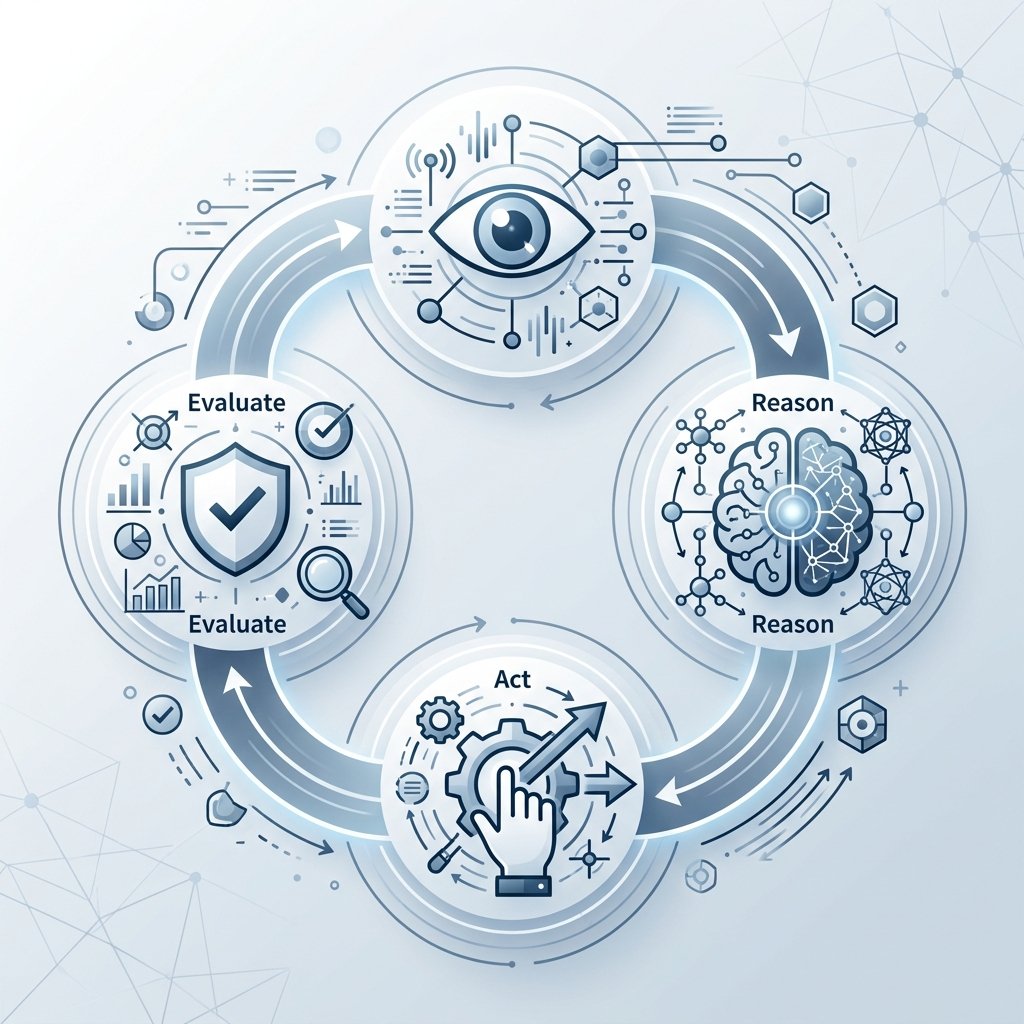
AI agents follow a continuous loop often described as the perceive-reason-act cycle:
- Perceive: The agent receives input – this could be a user instruction, data from an API, the contents of a file, or the result of a previous action.
- Reason: Using an underlying LLM or reasoning engine, the agent determines the best course of action to move toward its goal.
- Act: The agent executes an action – running a search query, writing a piece of code, calling an API, or passing a task to another agent.
- Evaluate: The agent reviews the outcome and decides whether to continue, adjust its approach, or report back to the user.
This loop continues until the task is complete or the agent determines it cannot proceed without human input. The ability to self-correct and adapt mid-task is what separates AI agents from simpler, linear automation tools.
Key Components of an AI Agent
Most AI agents share a common architecture built around four core components:
- Reasoning engine: Typically a large language model that processes information and determines next steps.
- Memory: Storage that allows the agent to retain information across steps or sessions (more on this below).
- Tools: External capabilities the agent can call upon, such as web search, code execution, database queries, or API integrations.
- Planning module: A system for breaking down complex goals into manageable subtasks and sequencing them logically.
The sophistication of each component varies widely across different AI agent frameworks, from lightweight single-purpose agents to complex multi-agent systems.
What Is AI Agent Memory?
Memory is what gives AI agents the ability to maintain context over time. There are generally four types of memory used in AI agent design:
- In-context memory: Information held within the active prompt window – temporary and limited by the model’s context length.
- External memory: Databases or vector stores the agent can query to retrieve relevant information on demand.
- Episodic memory: A record of past interactions or completed tasks, allowing the agent to learn from prior experience.
- Semantic memory: Stored knowledge about facts, entities, and relationships that the agent can draw upon when reasoning.
The more sophisticated an agent’s memory system, the better it performs on long-horizon tasks that require sustained context and accumulated learning.
What Can AI Agents Do?
The capabilities of AI agents span a wide range of tasks, particularly those that are multi-step, require tool use, or demand decision-making over time. Common AI agent use cases include:
- Research and summarization: Autonomously gathering information from multiple sources and synthesizing it into a report.
- Code generation and debugging: Writing, testing, and iterating on code without step-by-step instruction.
- Data analysis: Querying datasets, identifying patterns, and generating insights.
- Customer service workflows: Handling complex support queries by accessing account data, processing requests, and escalating when necessary.
- Content production: Drafting, editing, and publishing content across platforms.
- Task automation: Managing calendars, sending communications, filling forms, and executing workflows across connected software.
The common thread across all of these is the agent’s ability to complete tasks that previously required human judgment at multiple decision points.
Real-World AI Agent Examples
AI agent tools are already being deployed across industries. Several high-profile AI agent examples illustrate the breadth of current applications:
- Devin by Cognition AI is an AI software engineer capable of planning and executing entire coding projects, from writing code to running tests and deploying fixes.
- AutoGPT is an open-source AI agent framework that allows users to define a goal and let the agent autonomously research, plan, and act to achieve it.
- Microsoft Copilot Agents are embedded within Microsoft 365 and can automate tasks across Word, Excel, Outlook, and Teams – coordinating actions across apps with minimal user input.
- Salesforce Agentforce enables businesses to deploy autonomous agents within CRM workflows, handling customer interactions, case routing, and data updates without human intervention.
These AI agent tools represent real deployments at scale, not theoretical prototypes.
AI Agents vs. Chatbots: What’s the Difference?
The AI agents vs. chatbots distinction is worth understanding clearly, because the two are often conflated.
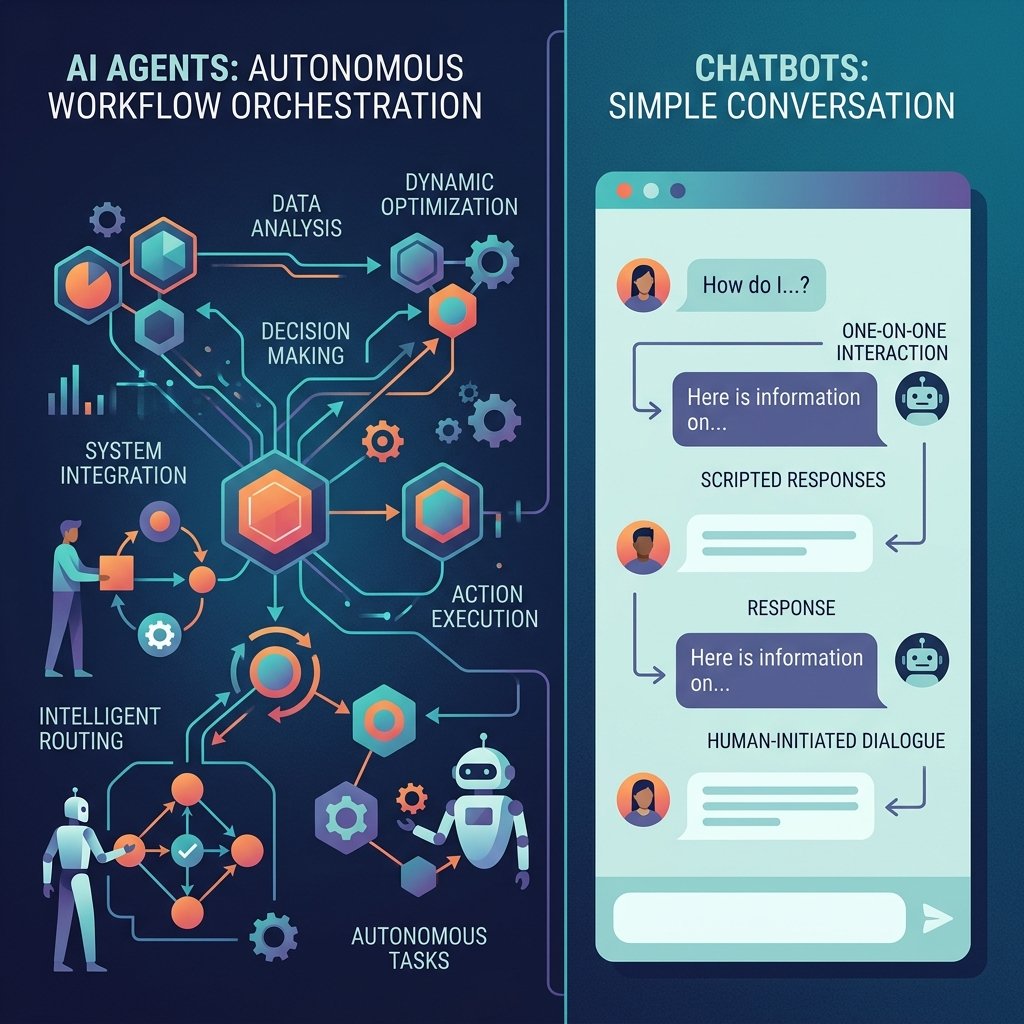
A chatbot is a reactive system. It responds to what you say, typically within a single turn or a short conversational window. Chatbots like early versions of customer service bots follow scripted decision trees or generate responses using a language model – but they do not take actions in the world, and they do not maintain goals across sessions.
An AI agent is proactive. Given a goal, the agent figures out how to achieve it, breaks the task into steps, uses tools, and iterates until the work is done. The agent is not just responding – it is operating.
A simple way to frame the distinction: a chatbot tells you how to book a flight. An AI agent books it for you.
AI Agents vs. AI Assistants: How Are They Different?
AI assistants – like Apple’s Siri, Amazon’s Alexa, or earlier versions of ChatGPT – occupy a middle ground. They can take limited actions (setting reminders, playing music, answering questions), but they are fundamentally designed to assist within a narrow scope and typically require human confirmation at each step.
AI agents go further. They can operate over longer time horizons, handle ambiguity, chain together multiple tools, and complete tasks that span multiple systems – often without checking in at every stage. The key differentiator is the degree of autonomy and the complexity of tasks the system can handle end to end.
Single AI Agents vs. Multi-Agent Systems
Not all AI agent deployments look the same. A single AI agent handles tasks on its own, using a set of predefined tools and reasoning capabilities. This works well for contained, well-defined workflows.
Multi-agent systems involve multiple specialized agents working in parallel or in sequence. One agent might handle research, another might generate a draft, and a third might handle quality review and publishing. This architecture allows for more complex workflows and enables each agent to specialize, improving overall performance.
Frameworks like LangChain, AutoGen from Microsoft, and CrewAI are designed specifically to coordinate multi-agent systems, allowing developers to define roles, handoffs, and communication protocols between agents.
Benefits of AI Agents
The benefits of AI agents for businesses and developers are substantial:
- Scalability: AI agents can run continuously and handle volumes of work that would be impossible for human teams alone.
- Speed: Agents complete multi-step tasks in minutes rather than hours, dramatically accelerating workflows.
- Consistency: Unlike humans, agents don’t get fatigued, distracted, or inconsistent. They apply the same logic and standards every time.
- Cost efficiency: Automating complex workflows reduces the labor cost of repetitive or time-intensive tasks.
- Adaptability: Modern AI agents can handle unexpected situations by reasoning through them rather than failing when they encounter edge cases.
Limitations and Risks of AI Agents
AI agents are powerful, but they come with real limitations that organizations need to account for:
- Hallucination: LLM-based agents can generate incorrect information and act on it, leading to compounding errors across a workflow.
- Lack of common sense: Agents can miss context that would be obvious to a human, resulting in technically correct but practically wrong outputs.
- Security vulnerabilities: Agents with broad tool access can be exploited through prompt injection attacks, where malicious content in the environment manipulates the agent’s behavior.
- Unpredictability: The more autonomy an agent has, the harder it becomes to predict exactly how it will behave in novel situations.
- Cost: Running complex agentic workflows with powerful LLMs can be expensive at scale, particularly for high-frequency tasks.
Responsible deployment requires human oversight mechanisms, defined guardrails, and regular auditing of agent behavior.
When Should You Use an AI Agent?
AI agents are not the right solution for every problem. They add the most value when:
- The task is multi-step and requires making decisions at each stage, not just generating a single output.
- The task requires tool use – searching the web, querying a database, or interacting with an API.
- The task is repetitive at scale, where the overhead of building and maintaining an agent pays off over many executions.
- Speed and throughput matter, and waiting for human action at each step creates a bottleneck.
For simple, one-shot tasks – answering a specific question, drafting a single email, summarizing a document – a standard AI assistant or LLM is usually sufficient, faster, and cheaper.
How Businesses Can Use AI Agents
Across industries, AI automation through agents is reshaping how work gets done. Practical business applications include:
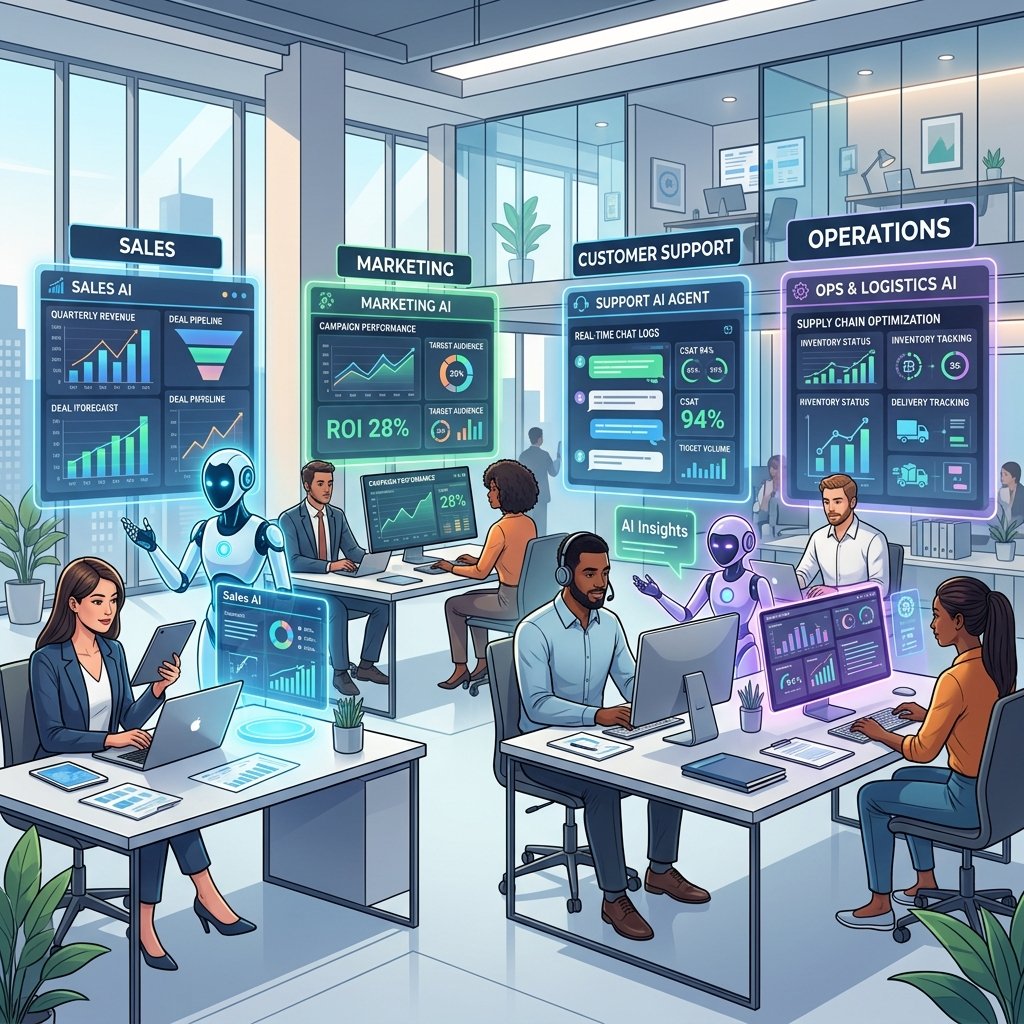
- Sales: AI agents can research prospects, personalize outreach, schedule follow-ups, and update CRM records autonomously.
- Marketing: Agents can monitor campaign performance, generate content variations, and optimize spend across platforms without manual intervention.
- HR and recruiting: AI agents can screen resumes, schedule interviews, and send candidate communications – compressing weeks of work into hours.
- Finance: Agents can reconcile transactions, flag anomalies, and generate financial summaries from raw data.
- IT operations: AI agents can monitor systems, diagnose issues, and execute remediation steps before a human is ever paged.
The businesses seeing the most impact are those treating AI agents not as replacements for human teams, but as force multipliers – handling the volume work so that people can focus on higher-order decisions.
What Is the Future of AI Agents?
The trajectory of AI agents points toward greater autonomy, broader capability, and deeper integration into enterprise systems. Several trends are shaping where the technology is heading:
More capable underlying models will improve agent reasoning, reducing errors and expanding the complexity of tasks agents can reliably complete.
Standardized protocols like Anthropic’s Model Context Protocol (MCP) are emerging to make it easier for agents to connect with external tools and data sources consistently.
Agent-to-agent communication will become more sophisticated, enabling large networks of specialized agents to collaborate on enterprise-scale workflows.
Regulatory frameworks are being developed globally to address accountability, transparency, and safety in agentic AI systems – particularly in high-stakes domains like healthcare, finance, and legal services.
The question for most organizations is no longer whether AI agents will become central to how work gets done. It’s how quickly they can build the infrastructure and expertise to deploy them responsibly.
Frequently Asked Questions
What is an AI agent in simple terms?
An AI agent is a software system that can take actions to complete a goal on your behalf. You give it an objective, and it figures out how to achieve it – using tools, making decisions, and adapting along the way – without needing you to guide every step.
How are AI agents different from chatbots?
Chatbots respond to questions within a conversation. AI agents pursue goals across multiple steps, using external tools and making decisions autonomously. A chatbot explains how to do something; an AI agent does it for you.
What tools do AI agents use?
AI agents commonly use tools like web search, code execution environments, APIs, databases, email clients, and file systems. The specific tools available depend on how the agent is configured and what permissions it has been granted.
Are AI agents safe to use?
AI agents carry real risks, including the potential for errors, security vulnerabilities, and unpredictable behavior in complex situations. Safe deployment requires defined guardrails, human oversight, and regular auditing of agent activity.
What are the best AI agent frameworks available in 2024?
Popular AI agent frameworks include LangChain, AutoGen (Microsoft), CrewAI, and LlamaIndex. Each offers different strengths depending on whether you need a single-agent setup or a coordinated multi-agent system.
Can small businesses use AI agents?
Yes. Several AI agent tools are designed for non-technical users and integrate with common business software. Platforms like Microsoft Copilot and Salesforce Agentforce provide agent capabilities without requiring custom development.
Comments